Articulate
Angled rotating interfaces create directional movement within a compact module.

MODULAR ARTICULATION
ENGINEERING PLATFORM
REM ARTICULATION
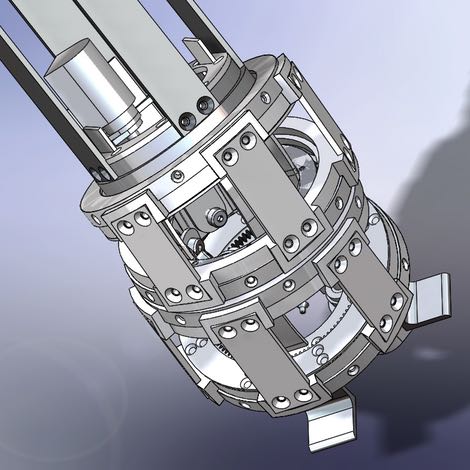
REM is a patented modular articulation architecture that combines multi-axis motion with a protected central pathway for power, data, hydraulics, pneumatics and other services.
THE IDEA
Traditional articulated machines often force engineers to manage cables, hoses and other services around moving joints. REM places a hollow service pathway at the centre of the articulation architecture.
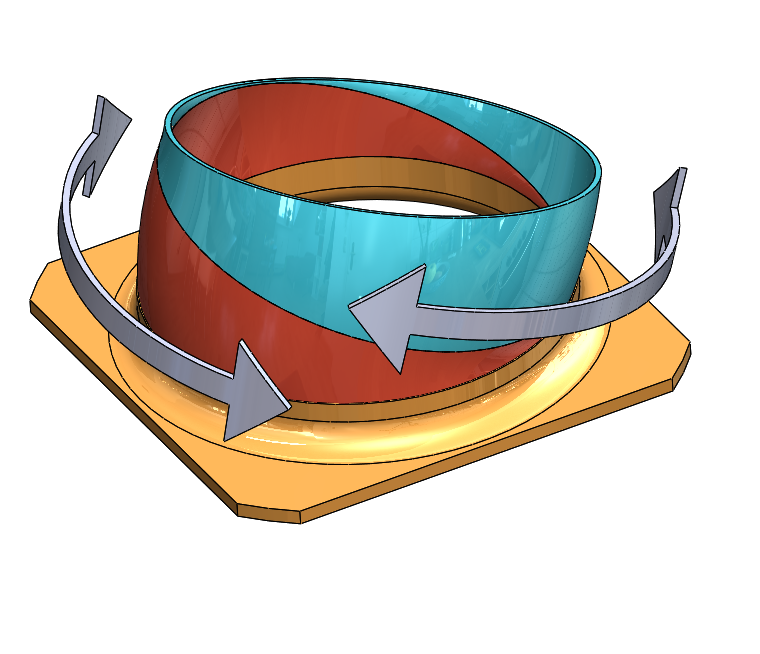
Angled rotating interfaces create directional movement within a compact module.
A hollow spool and internal passages allow services to continue through the moving architecture.
Modules can be used individually or connected to form longer articulated manipulators.
HOW IT WORKS
The patent describes hollow spool members, angled ring/envelope members and independently driven rotational interfaces. Service connections can pass through the hollow interior while modules articulate around them.
Provides the central structural and service-routing pathway.
Angled ring geometry changes the orientation of the neighbouring structure.
Drive mechanisms rotate interfaces independently to create a range of motion.
Additional modules extend the articulated chain for application-specific reach and motion.
TWO AUDIENCES. ONE TECHNOLOGY.
FOR ENGINEERS
Review the geometry, prototype status, engineering questions, validation plan and the data REM should establish before application-specific design.
FOR INVESTORS & PARTNERS
Review the IP position, potential commercialization models, initial market wedge, de-risking milestones and partnership strategy.
APPLICATION PATHS
REM should earn credibility one application at a time. These are candidate paths—not claims of production readiness.
Welding, process tooling and manipulators where service bundles must follow the end effector.
Attachment articulation for excavators and other machinery—the patent explicitly describes an excavator configuration.
Cameras, sensors and tools operating in confined or difficult environments.
Research, medical and precision systems where compact routing and multi-axis orientation may matter.
EVIDENCE OVER ADJECTIVES
The new site treats REM as an engineering program. It shows what exists, what public IP supports, and what must be measured next.
Patented modular manipulator architecture.
Two-module, gear-driven demonstrator shown publicly.
Torque, loads, stiffness, backlash, range, lifecycle and service-path testing.
Integrate REM into one carefully selected real-world use case.
Convert technical validation into commercial evidence.
INTELLECTUAL PROPERTY
Public patent records identify the “Manipulator arm module” family with granted Canadian, U.S. and European patent publications. Patent status should always be confirmed during formal diligence.
BUILD THE NEXT EVIDENCE WITH US
REM is best evaluated against a concrete constraint: motion envelope, service routing, packaging, maintenance or tool orientation.