LOWER CAPITAL
Technology licensing
License the architecture by field of use, geography or application to established OEMs.
- Potentially capital-light
- Relies on partner execution
- Requires strong IP and technical support

MODULAR ARTICULATION
ENGINEERING PLATFORM
INVESTORS & STRATEGIC PARTNERS
The investment case is not “a joint for every industry.” It is a patented articulation architecture that could be licensed or engineered into selected machine categories—if validation proves a meaningful advantage.
THE CASE IN SIX LINES
Articulated machines often need power, data or fluids to reach tools through repeated motion and constrained geometry.
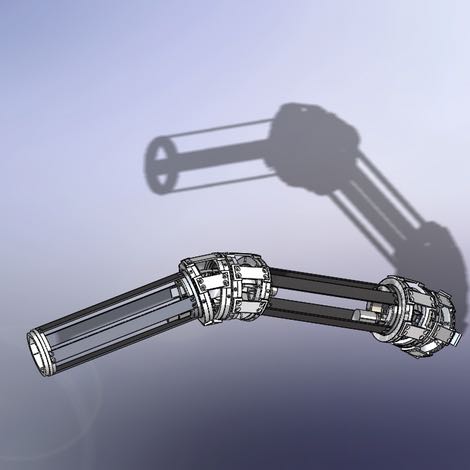
REM combines angled rotating interfaces with a hollow internal pathway and modular stacking.
Public granted patent publications and a physical two-module demonstrator establish more than a conceptual starting point.
Focus on machines where service-line management, articulation and maintenance create measurable pain.
Commercialization can be matched to REM’s capital strategy and each market’s certification/manufacturing burden.
The next de-risking milestones are engineering characterization and an OEM/application demonstrator.
* International Federation of Robotics, World Robotics 2025: 542,000 industrial robots installed in 2024 and 4.664 million in operation globally. These figures describe the broader robotics environment; they are not REM’s addressable market.
MARKET DISCIPLINE
A defensible market model starts with a narrow application segment, counts addressable machines or joints, and uses an achievable value per deployment. Expansion comes after technical proof.
One application with costly service routing and clear integration access.
Similar load, service and motion requirements where the same module platform can adapt.
Different industries can be commercialized through partners without REM building every end product.
COMMERCIALIZATION OPTIONS
The existing REM site references master licences. The redesigned story broadens the possibilities but does not assume they are equally attractive.
LOWER CAPITAL
License the architecture by field of use, geography or application to established OEMs.
BALANCED
Co-develop a validated application with an OEM, then license the resulting configuration.
HIGHER CAPITAL
Standardize and manufacture qualified REM modules for integrators and OEMs.
VALUE INFLECTIONS
A funding request is more credible when each tranche is tied to a de-risking milestone rather than a generic promise to “commercialize.”
Build a reliable engineering data sheet and failure-mode understanding.
Integrate into one real application and benchmark the incumbent architecture.
Independent test/review and partner acceptance against agreed requirements.
First paid development, pilot, licence or supply agreement.
INVESTOR DILIGENCE
A serious investor will test both the mechanism and the company’s ability to turn it into a repeatable business.
Show the granted claims, ownership chain, remaining term and how proposed commercial embodiments map to the claims. Separate patentability from freedom to operate.
Provide test reports for torque, loads, stiffness, backlash, repeatability, lifecycle and service routing. Where data does not exist, say so and present the test plan.
Name the first application segment, quantify the incumbent pain and show direct customer or engineering-partner discovery.
Define the intended balance between licensing, joint development and manufactured modules, along with economics and partner responsibilities.
A credible answer is a quantified prototype, independent review and one application demonstrator leading to a pilot or licence discussion.
INVESTMENT & STRATEGIC CAPITAL
A first conversation should focus on IP, current prototype status, the proposed validation program and the market wedge—not broad industry claims.