
ENGINEERING
Built to be questioned.
Engineers should not have to reverse-engineer a marketing claim. This page separates public prototype facts from the measurements, interfaces and validation work required for serious design evaluation.
ENGINEERING STATUS
What the public material establishes—and what it does not.
A credible engineering website should make this distinction obvious. “Not yet published” is better than an unsupported number.
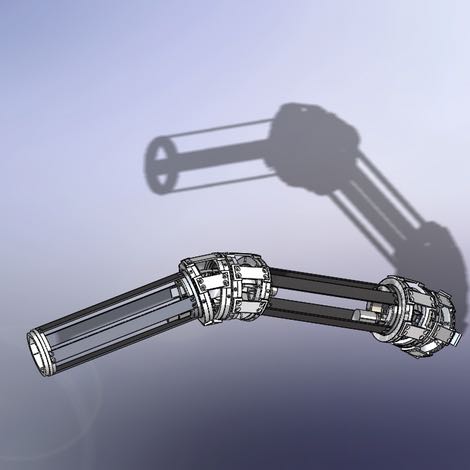
- Two-module, gear-driven prototype is shown on the existing REM website.
- Prototype is described as approximately 7.5-inch outside diameter.
- Patent documents describe hollow spool members and internal service/control connections.
- Patent documents describe independently driven rotating rings/envelope members.
- Modules are described as usable individually or connected into a manipulator arm.
- Rated and peak torque; bending moment; axial and radial load.
- Backlash, torsional stiffness, repeatability and positional accuracy.
- Angular range, speed and continuous-rotation operating envelope.
- Cycle life, wear modes, lubrication and maintenance intervals.
- Clear internal bore/service envelope under motion and load.
SPECIFICATION FRAMEWORK
The numbers an OEM will eventually need.
This is the recommended technical data model for the next prototype and test program. Values remain intentionally blank until measured and documented.
- Outside diameter
- Prototype: 7.5 in
- Clear bore
- To measure
- Module length
- To measure
- Mass
- To measure
- Degrees of freedom
- Up to 2 / module
- Angular range
- To test
- Rotational speed
- To test
- Motion repeatability
- To test
- Continuous torque
- To test
- Peak torque
- To test
- Bending moment
- To test
- Axial/radial load
- To test
- Backlash
- To test
- Torsional stiffness
- To test
- Position accuracy
- To test
- Resolution
- Drive-dependent
- Power
- Architecture supports routing
- Data
- Architecture supports routing
- Hydraulic / pneumatic
- Described in patent
- Minimum bend / twist
- Application-specific
- Cycle life
- To test
- Environmental sealing
- To design / test
- Temperature range
- To qualify
- Maintenance interval
- To establish
VALIDATION PROGRAM
Turn the prototype into a quantified mechanical system.
A concise test program can generate the evidence investors, OEMs and engineers all need. The same data de-risks both the machine and the business case.
- 01Metrology & baseline characterization
Document dimensions, mass properties, clear service envelope, drive ratios and motion limits.
- 02Static load & stiffness testing
Measure torque capacity, bending moment, deflection, backlash and structural behaviour.
- 03Dynamic motion testing
Characterize speed, repeatability, control response and motion coupling across configurations.
- 04Service-line endurance
Route representative power, data and fluid lines and monitor bend, twist, abrasion and thermal effects.
- 05Lifecycle & failure-mode testing
Run accelerated cycles, inspect wear modes and establish service/maintenance assumptions.
- 06Application-specific prototype
Choose one high-value use case and compare REM against the incumbent architecture using shared metrics.
INTEGRATION QUESTIONS
Bring the constraints before choosing the configuration.
A useful REM evaluation starts with the machine—not the joint. The following inputs define whether the architecture deserves deeper work.
ENGINEERING PARTNERS
Have a machine where routing and motion fight each other?
Send the application constraints. The most valuable next step is a scoped feasibility review, not a generic sales call.